Key insights from Dan Tomaszewski’s conversation with Andy Cormier on The Stack
The MSP industry has never lacked predictions. Every year brings a new wave of tools, buzzwords, and bold promises about what’s going to “change everything.” But separating meaningful progress from marketing noise is getting harder, especially as AI accelerates, security grows more complex, and Microsoft continues expanding its footprint across nearly every IT workflow.
That tension sits at the heart of a recent episode of The Stack, where host Dan Tomaszewski speaks with Andy Cormier, an MSP veteran and Syncro’s resident Channel Chief. Rather than chasing hype, the conversation focuses on what MSPs will actually need to operationalize over the next few years, and why those shifts matter to day-to-day efficiency, profitability, and client experience.
What emerges isn’t a list of shiny trends, but a practical roadmap: how AI matures into real business value, why security consolidation is becoming inevitable, how Microsoft is reshaping operational workflows, and how something as unglamorous as billing accuracy can quietly make or break margins.
Check out the full interview below, or keep reading to get the key points of Andy and Dan’s conversation.
AI Is Growing Up, and MSPs Will Feel the Difference
AI may be the most talked-about technology in the industry today, but Andy is quick to acknowledge that much of what MSPs see right now still feels experimental. Every product claims intelligence. Every platform promises automation. In practice, many tools deliver interesting tech demos rather than transformative operational impact.
That’s not because AI lacks potential. It’s quite the opposite, actually. Andy views AI as one of the most transformative technologies of our lifetime. The problem is that the industry is still working through a noisy phase where the label “AI” gets applied so broadly that it starts losing meaning. The result is confusion for buyers and inflated expectations that tools can’t yet meet.
What changes this dynamic isn’t more features, it’s context and specificity. The real leap happens when AI starts working directly inside operational data and workflows. Instead of simply generating content or scripts, imagine systems that analyze historical contracts, renewal behavior, pricing patterns, or service trends and surface insights that directly improve decisions. That’s where AI stops being interesting and starts being operationally useful.
For MSPs, this matters because differentiation won’t come from simply adopting AI tools. It will come from how effectively those tools improve outcomes: faster quoting, smarter pricing decisions, better renewal forecasting, or more efficient internal workflows. Andy also emphasizes that MSPs should live with these tools internally before offering them to customers. You can’t confidently operationalize something you haven’t pressure-tested inside your own business.
The takeaway isn’t to avoid AI. It’s to be intentional with it. The next phase rewards clarity over curiosity, measurable value over novelty, and discipline over experimentation for its own sake.
Security Is Reaching a Breaking Point
Security has followed a similar trajectory: rapid growth, increasing complexity, and an explosion of overlapping tools and terminology. MSPs are asked to navigate EDR, MDR, XDR, identity protection, compliance mandates, cyber insurance requirements, and an ever-growing vendor ecosystem, all while trying to translate this complexity into something customers can understand and trust.
This challenge is just as much operational as it is technical. Many MSPs find themselves deploying tools they haven’t fully mastered, which creates uncertainty about coverage, configuration, and diminishing returns. When everything feels critical, it becomes difficult to prioritize effectively or explain real risk versus perceived risk to customers.
Andy sees consolidation as the natural response. Instead of stitching together dozens of point solutions, the industry will move toward platforms that unify endpoint, cloud, identity, and monitoring under fewer operational surfaces. Simplification becomes a competitive advantage: fewer dashboards, clearer visibility, and more consistent response.
At the same time, staffing pressures are reshaping how MSPs approach security delivery. Recruiting and retaining experienced security talent has become increasingly expensive, making it unrealistic for many firms to maintain deep internal coverage. MDR and outsourced SOC services help level the playing field, allowing smaller MSPs to compete for more sophisticated customers without absorbing unsustainable labor costs.
The implication for MSPs is strategic. Security can’t remain an accumulation of disconnected tools and reactive decisions. It needs to become a streamlined, well-understood operational capability that balances protection, efficiency, and scalability.
Microsoft Isn’t Just in the Stack — It Is the Stack
A decade ago, Microsoft might have represented email servers or productivity tools. Today, it touches identity, security, collaboration, device management, automation, and increasingly — AI. MSPs routinely jump into Microsoft tenants dozens of times per day, handling resets, policy updates, access management, and troubleshooting.
This shift has created friction. When critical Microsoft workflows live outside core RMM and PSA platforms, technicians lose time context-switching between systems, managing permissions, and duplicating effort. Small inefficiencies compound across teams and customers.
Andy’s perspective reflects what many MSPs already feel operationally: Microsoft is no longer optional infrastructure. It’s the foundation. Tools that integrate Microsoft management directly into daily workflows reduce overhead, speed resolution, and improve consistency. As Microsoft continues expanding its ecosystem, MSPs that align their platforms and processes around that gravity will move faster and scale more effectively.
Operational maturity increasingly depends on reducing friction between where work happens and where data lives.
The Revenue Leak Most MSPs Don’t See
Perhaps the most tangible insight from the episode centers on something far less glamorous than AI or cybersecurity: billing accuracy.
Many MSPs still track third-party licenses, add-ons, and SaaS consumption manually. Over time, mismatches emerge between what customers actually use and what gets billed. Customers immediately flag overbilling, but underbilling often goes unnoticed for months or years.
Andy shared a real example of an MSP discovering more than $15,000 in missed revenue from a single customer due to manual tracking gaps. Multiply that across multiple services and clients, and the financial impact becomes significant.
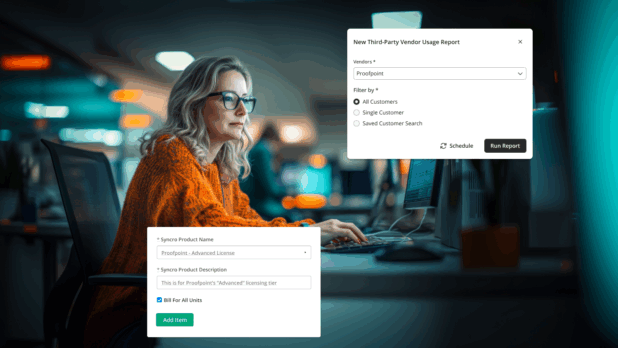
Automated usage syncing and recurring invoice reconciliation, often referred to as “universal billing,” directly address this blind spot. When consumption data flows automatically into billing systems, invoices stay accurate without constant human intervention. Beyond protecting revenue, this reduces administrative stress and improves operational confidence.
In a margin-sensitive business, eliminating silent leakage can have as much impact as winning new customers, without increasing workload or risk.
Building for What’s Actually Coming
What ties all of these themes together is a shift away from reactive growth and toward intentional operational design. AI becomes valuable when it improves real decisions. Security becomes sustainable when complexity is reduced and expertise is scalable. Microsoft becomes powerful when workflows are unified. Billing becomes strategic when accuracy is automated.
These aren’t abstract trends. They’re practical pressures already shaping MSP operations today. The MSPs that adapt thoughtfully won’t just survive the next wave of change; they’ll operate with greater efficiency, clarity, and resilience.
For leaders planning the next phase of growth, this episode offers a grounded lens for prioritization: invest where outcomes improve, simplify where complexity compounds, and operationalize what actually moves the business forward.
If you’d like to hear the full conversation and Andy’s insights firsthand, the episode is available on YouTube and major podcast platforms.

Share
Related Resources